
How to Choose the Right Electric Tarp System for Your Operation
The right tarp system starts with the trailer, the load and the workflow.
Need a recommendation?
Not sure which electric tarp system is right for your operation? Answer seven quick questions to receive an indicative recommendation based on your trailer, load and workflow.
Start the Tarp System Selector
Average completion time: less than 60 seconds.
Choosing the right electric tarp system isn’t about finding the “best” product. It’s about choosing the system that best fits your vehicle, load and workflow.
If you’d like a quick recommendation, start with the Razor Tarp System Selector at the end of the article. In less than 60 seconds, it will guide you towards the system that may best suit your operation. Alternatively, continue reading to understand the key factors that influence the decision.
No two operations are exactly the same. Vehicle type, load characteristics, loading method, operating frequency and application requirements all play a role in selecting the right solution. A system that performs well for one fleet may not be the best choice for another.
So, where should you start?
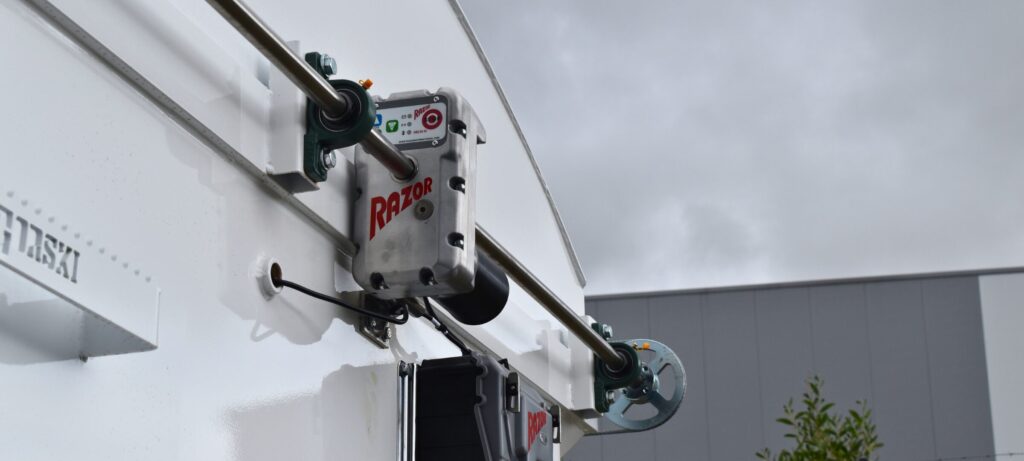
Start with the vehicle
First, look at the truck, trailer or body.
Its size, shape and existing hardware can all affect system selection. Available mounting space and operating clearance also matter.
Before choosing a system, check:
- vehicle, trailer or body type
- body length and width
- available mounting space
- existing tarp hardware
- required direction of tarp travel
- loading and unloading clearances
- new installation or retrofit
- access to power and controls
The aim is simple. Choose a system that works with the vehicle and its normal operating cycle.
Choose the right tarp movement
Not all electric tarp systems move in the same way.
A rollover tarp system moves the tarp across the body from side to side. A front-to-back tarp system moves along the length of the body.
Other powered options can automate an existing manual tarp process.
So, which setup is right for you?
Start by looking at how the vehicle is loaded. Then consider the load shape and available clearance. Loading equipment and site layout may also affect the choice.
The best option is the one that fits the way the vehicle actually works.
Consider the load profile
Next, look at what the vehicle carries.
Different loads create different demands. Loose bulk materials, high loads and uneven profiles can all affect tarp operation.
Ask:
- Is the load usually even?
- Can material sit high above the body?
- Is the vehicle loaded from above?
- Does the load profile change between jobs?
- Does the load need protection from weather or contamination?
- Are there clearance issues around loading equipment?
- Does the vehicle operate in dust, moisture, heat or cold?
Choose a tarp system around real loads and real sites. Do not base the decision on an ideal loading scenario.
It is also important to separate load covering from load restraint or cargo securement.
A tarp may help cover or contain a load. However, operators must assess restraint and securement requirements separately. Those requirements depend on the vehicle, cargo and rules in each market.[1][2]
Map the driver workflow
Now follow the driver through a normal cycle.
When is the tarp opened? When is it closed? Where does the vehicle stop? Does the driver need to leave the cab?
Also consider how often the process happens each day.
These questions can reveal unnecessary steps, delays and repeated manual tasks.
For example, frequent tarp use changes the equation. Small time savings can add up across a day, a fleet and a year.
In other operations, the main benefit may be different. Reducing repeated physical effort or limiting work around the outside of the vehicle may be the priority.
The system should fit the workflow, not add complexity.
Look beyond the motor
Electric operation is only one part of the decision.
Controls, installation and ongoing support also matter. Before choosing a system, consider:
- control options
- in-cab or remote operation
- manual override capability
- power supply
- mounting flexibility
- serviceability
- replacement parts
- compatibility with existing equipment
- supplier or distributor support
These details become more important in demanding operations. They also matter when vehicles work across multiple sites or travel long distances.
Razor electric tarp systems support a range of powered applications. Depending on the configuration, options may include wireless operation, remote control functionality, manual override capability and flexible installation setups.[4][5]
Consider frequency of use
How often will the tarp operate?
A system used once or twice a day has different demands from one cycling repeatedly across a shift.
For frequent use, look closely at:
- duty cycle
- operating speed
- driver interaction
- component durability
- ease of maintenance
- parts availability
- downtime risk
This is where a basic product comparison can fall short.
The real question is not simply whether a system can open and close the tarp. Instead, ask whether it suits the workload and operating conditions.
Think about safety and access
Manual tarping can involve climbing, reaching, pulling or winding. It may also require drivers to work around the outside of the vehicle.
Depending on the vehicle and site setup, electric tarping can help reduce repeated manual handling. It may also limit the need to access higher or harder-to-reach areas during normal operation.[3]
However, electric operation does not replace safe work practices. Training, maintenance and site procedures still matter.
The goal is a simpler and more consistent process for the driver.
Plan for service and support
Finally, think beyond installation.
Ask what happens when the system needs maintenance or parts.
Consider:
- Are replacement parts readily available?
- Can key components be serviced?
- Is technical information accessible?
- Is local or distributor support available?
- Can the system adapt if the operation changes?
- How easily can faults be diagnosed?
Upfront cost is only one part of system value. Poor parts availability or difficult servicing can create avoidable downtime later.
Which Razor Tarp System Suits Your Operation?
Every operation is different. Answer seven quick questions about your trailer, load and workflow to identify which Razor tarp system may suit your application.
Average completion time: Less than 60 seconds.
The selector provides an indicative recommendation only. Final system selection should be confirmed based on your vehicle dimensions, mounting points, load type and operating requirements.
Still not sure which tarp system fits your operation?
Talk to the Razor team about your vehicle, load and workflow.
References
[1] National Heavy Vehicle Regulator, Load Restraint Guide 2025 — provides best-practice guidance on load restraint systems, loading requirements and performance standards for heavy vehicles in Australia.
https://www.nhvr.gov.au/road-access/loading/load-restraint-guide
[2] Federal Motor Carrier Safety Administration, Cargo Securement Rules — outlines US requirements intended to prevent cargo from shifting on or within, or falling from commercial motor vehicles.
https://www.fmcsa.dot.gov/regulations/cargo-securement/cargo-securement-rules
[3] Oregon OSHA, Tarping and Fall Protection — Information for Truckers — provides guidance on fall hazards when adjusting, removing or applying tarps from the top of a load.
https://osha.oregon.gov/OSHAPubs/factsheets/fs36.pdf
[4] Razor International, Rollover Tarp System — provides product information on Razor powered rollover tarp configurations and operating features.
https://www.razorinternational.com/product/razor-dii-rii-rollover-tarp-system/
[5] Razor International, Electric Power Tarp Systems — provides product information across Razor’s electric tarp system range.
https://www.razorinternational.com/product-category/electric-power-tarp-systems/